
| Name | Date of listing | Issue Price | closing price | closing price | % gain loss | change over |
| 18th April | 12th March | over week | lssue price | |||
| CARE | 26th December | 750.00 | 746.35 | 755.00 | -1.15 | -0.49 |
| PC Jeweller | 27th December | 135.00 | 101.60 | 107.95 | -4.70 | -24.74 |
| Bharti Infratel Limited | 28th December | 220.00 | 169.65 | 171.00 | -0.61 | -22.89 |
| V-Mart Retail Limited | 20th February | 210.00 | 169.15 | 160.00 | 4.36 | -19.45 |
| Repco Home Finance Limited | 1st April | 172.00 | 172.15 | 170.90 | 0.73 | 0.09 |
Performance of Newly Listed Shares as on 18th April 2013
April 22nd, 2013
Comments Off on Performance of Newly Listed Shares as on 18th April 2013
Preferential Allotment, CDR, Companies Act and Corporates
April 22nd, 2013
Comments Off on Preferential Allotment, CDR, Companies Act and Corporates
The times through which are economy is passing is certainly not stressful and the same is seen in the state of banks where NPA’s have been rising sharply. At the same time one also sees the banks becoming aggressive against those companies where the promoters are seen as resourceful but are not honouring the commitment made by their companies.
The companies which are genuine and facing hardship are being supported by banks through a special cell set up by RBI called CDR. The cell admits companies which have undergone stress and restructures loans of such companies. A pre-requisite for admittance to this cell for a company is that the company should be viable and that the promoter or promoter group should be prepared to bring in capital to make the unit viable.
SEBI under its ICDR allows companies to raise capital through preferential offer to promoters and promoter group provided they have not sold any shares in the previous six months. There is a grey area as to whether sale of pledged shares by lenders is to be treated as sale of shares or not? The general understanding of the law as of today is that pledged shares sold on account of fall in market price triggering loss of mark to market value or non-repayment of loans taken amounts, to promoter sale of shares.
The ambiguity in law starts here. Stock Exchanges are SRO’s or self-regulatory bodies deriving powers from SEBI and also companies act. Issue of capital is a function of SEBI but CDR is a cell under RBI and Ministry of Corporate Affairs MCA. Companies may seek in principle clearance from the stock exchanges for the issue of preferential allotment to promoters and promoter groups but the exemption required from the ICDR regulation of no sale in six months cannot be given by stock exchanges or SEBI. This is only possible by getting the same from MCA as they would approve the allotment and not give exemption under the ICDR regulation.
These days companies in their zest to get the preferential allotment approved by their general bodies get complicated and all empowering resolutions voted upon without realising that there would be further complications as the resolutions approved are incorrect in the first place. ICDR stipulates that there should be no sale for 6 months prior, there should be a reference date and the allotment should be done within 15 days. In the case of CDR package the rule of six months is to be waived because the companies going for CDR which is approved would have allotment on a preferential basis as a precondition. Secondly in many cases companies restructuring also entails conversion of existing loans into equity for lenders.
A very important point in all this is the fate of the minority shareholder who simply does not understand the implications of a special resolution being voted upon. There are enough instances where a handful of motivated minority shareholders attend the EGM and ensure that the resolution is passed on receiving small favours. All such special resolutions must henceforth entail a minimum number of minority shareholders in terms of percentage of shares voting for the resolution to be approved.
One hopes that companies which are really interested in coming out of the stressed conditions and are serious about their CDR package do a little bit of housekeeping, understanding the law and then proceed. Delays in restructuring on account of procedural lapses or issues could damage the long term interest of companies, their promoters and certainly their shareholders.
Infosys and the markets
April 15th, 2013
Comments Off on Infosys and the markets
Infosys has been the market leader in the IT space and has kicked of the declaration of quarterly results each time. It was no different this time either. In the last five quarters beginning with results for 4th Quarter for 2011-12 it has been observed that there have been gap down opening post the result on 4 out of five quarters, with just the December Quarter having a gap up opening. Infosys has always declared its results prior to the markets opening and therefore the market has sort of made up its mind prior to opening itself of how the results are.
From the table below one can see the impact of the gap down on the SENSEX and NIFTY. What is surprising is the fact that the one occasion when Infosys gained Rs 393 or 14.49%, The SENSEX was flat while the NIFTY was down 0.29%. Results of Infosys have had a marginal impact on TCS with the share reacting 1.63% against the 21.35% fall recorded in Infosys.
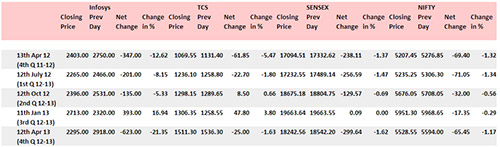
Coming to the results this time around, there were a couple of issues that did not go down well. The company was able to meet analyst expectations on revenue as per Bloomberg estimates, while the profits were marginally better than analyst estimates. What spooked the market was the fact that the company has given guidance only on revenues for the next year. Earlier it gave guidance also on earnings and margins. The revenue guidance is a growth of 6%-10% which is lower than Nasscom estimates of 12%-14%. Analysts seem to be reading too much into the fact that mere revenue guidance has been given and no margins or profit related guidance has been given. Most other companies have not been giving similar guidance at all.
In the last ten years the net profits of Infosys have grown 10 fold from Rs 958 crs to Rs 9,421 crs. Sustained growth year after year and at a level of almost Rs 10K crs is not many companies can boast of. The company has grown at much higher percentages than the projected single digit currently and therefore traded at higher multiplesearlier. The current earnings for the year ended March 2013 is Rs 164.87 which at the current price of Rs 2295 translates into a PE multiple of 13.92 times. The general expectation for the SENSEX and NIFTY companies for the current year is that they would see a slowdown in earnings. In such a scenario one could be quite sure that Infosys based on current earnings is certainly not expensive than the basket of earnings of the benchmark indices. If such be the case, why the apathy towards the company?
I believe the answer lies somewhere else and a similar incident comes to mind. Hindustan Lever as the company was then known had Mr VindiBanga as its Managing Director around the 2000-2004 period. The company was great and the person very capable. Something just did not click and the company’s performance and stock price kept on slipping. The Unilever shifted Mr Banga to a bigger responsibility to look after a larger geography and then on the fortunes of HLL changed. It was a case of the right person at the right place but at the wrong time.
Could it be possible that the present head of Infosys Mr Shibulal is in a similar situation where he is the right person at the right place but at the wrong time?
In conclusion, I believe the Infosys story is not over. What has happened on Friday is an aberration and though some more fall today and tomorrow cannot be overruled, good companies cannot be written off.