
MT Educare: Share makes stellar debut-Gains 13%


MT Educare Limited made its debut on the bourses yesterday and had a great day. The company had issued shares in a fresh offer and an offer for sale in the price band of Rs 74-80. The price discovery of the issue happened at Rs 86.05 which was a gain of a little over 7.5%. The share opened at Rs 86.05 which was also the low of the day on both the exchanges and closed at the high of the day which was Rs 90.35. The close was at the maximum permissible 5% gain allowed on listing and for the ten days of trading when it is traded in ‘trade-to trade’ category. This category means that every trade is settled by delivery and no netting of is permitted.

Exchange Open High Low Close Net Change % Gain/loss Wt. Avg Volume Delivery Del %age
BSE 86.05 90.35 86.05 90.35 10.35 12.94 89.40 1600133 1600133 100.00
NSE 86.05 90.35 86.05 90.35 10.35 12.94 89.76 751076 751076 100.00
Total 2351209 2351209 100.00

The stock hit the upper circuit level within minutes of opening for trade and remained locked at the upper circuit level throughout the trading day. Even though the share was locked at upper circuit trades have continued throughout and some trading or the other has happened. The share saw a total trading of 23,51,209 shares and this volume was 19% of the IPO size of 123.75 lac shares. The volume considering the circuit at virtually the open itself is significant. There was buying from one HNI and as per details available in bulk trading on the two exchanges, a total of 8.88 lac shares have been purchased by the person in his and family names.

The weighted average of the day’s trade was 89.40 on the BSE and Rs 89.76 on the NSE. The net gain for the investor at the closing price was Rs 10.35 or 12.94%.

The price chart shows how the stock hit the upper circuit or the maximum permissible upper limit of 5% at virtually the open and remained there throughout the trading day. Volume kept on happening throughout the day and it appears that retail investors may have been selling.

The IPO was subscribed an overall 4.8 times with the QIB portion subscribed 6 times and HNI portion subscribed 8 times. Retail portion was subscribed 2.17 times.

The issue has opened well and one would expect the buying fervour witnessed on the opening day to continue for some time.
National Buildings Construction Corporation: Listing day is poor show


Share closes with losses of 8.5%

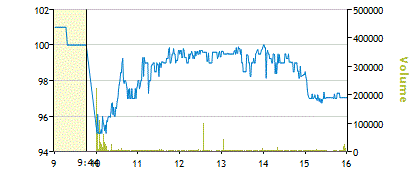
National Buildings Construction Corporation Limited (NBCC) which had tapped the capital markets with its offer for sale of 1.2 cr shares listed on the exchanges yesterday. The offer for sale was in a price band of Rs 90-106 and had a discount of 5% for retail and eligible employees. The price discovery itself saw the share price fall and the same was discovered at Rs 100 on the BSE. The open was at Rs 100; the high was Rs 101, the low 95.05 and the close Rs 97.05. On the NSE the price discovery was at Rs 101 which was the open and high, the low was Rs 95.95 and the close was Rs 96.95. The listing was certainly below the mark and also expectations.

Exchange Open High Low Close Net Change % Gain/loss Wt. Avg Volume Delivery Del %age
BSE 100.00 101.00 95.05 97.05 -8.95 -8.44 97.72 1212032 1212032 100.00
NSE 101.00 101.00 95.95 96.95 -9.05 -8.54 97.89 940724 940724 100.00
Total 2152756 2152756 100.00

The total traded volume on the two exchanges was 21,52,756 shares which was 17.93% of the IPO size of 120 lakh shares and the weighted average was Rs 97.72 on the BSE and a marginally higher Rs 97.89 on the NSE. Considering the discount of 5% given to retail investors the allotment price to them was Rs 100.70 which meant that even after the discount, they have lost money.

The price chart indicated that immediately after the open the the share touched the low which was the circuit filter level and was down a little over 10%. From those levels the share recovered to almost the Rs 100 level and hovered thereabouts till 2pm and then fell to close at around the 97 level a net loss of Rs 9 and percentage fall of about 8.5%.

The previous offerings from the Government have not done too well and there has been apathy towards government offerings. This issue was a way to test the markets by the government and was if one may so a really small cap offering from them. The issue was for 1.2 cr shares and the amount to be raised a paltry Rs 127.2 crs. The pricing was probably the key here and many people may have felt that the huge price band from Rs 90-106 showed the uncertainty in the mind of the seller and the merchant banker about the correct valuation of this company. The price band differential of Rs 16 was close to 15% and in recent times one has not seen such a big difference in the price band.

Yet another reason being attributed could have been the timing of the issue which was in the last week of March, but that logic does not hold ground as the issue was well subscribed in all categories with the QIB portion subscribed 7.07 times and the retail category subscribed 3.4 times. The employee category was undersubscribed and against a reservation of 1,20,000 shares just 11,340 shares were subscribed. Probably the employees knew more than the rest of the market.

All in all the issue NBCC had a bad listing and would go down as yet another issue which has not rewarded investors. One hopes this becomes a guiding light to the issuers of capital and the merchant bankers when they bring further issues.

Good week for shareholders, governance

It all began as a small issue of a minority shareholder fighting to protect its interests in a company but suddenly it has attracted national interest, hogging headlines in the press. Coal India Ltd (CIL) and corporate governance have been on a head-on collision course. The issue of fuel supply agreement (FSA) and penalties on not fulfilling the supply agreement had independent directors, shareholders and investors worried. At the same time, the government was worried that not being able to ensure implementation of the FSA would mean power shortages in the country.

Independent directors on the board of CIL rose to the occasion and voiced their protest in favour of shareholders. Consequently, a ‘Presidential Directive’ was issued to CIL to sign the FSA. The directive diluted many of the concerns of the shareholder and in the end, the shareholder won. It was a victory for corporate governance, as well.

For one, CIL has been allowed to decide the terms and conditions of the agreement. Some of the terms now being talked about include a pact only if the power producer has an agreement for power supply of 20 years. Further, the agreement would apply to the quantity that has been contracted for 20 years. For imported coal, it would be on a cost-plus basis.

After meeting all these conditions, if a short supply ensued, it would result in a penalty, which would be decided by CIL. All in all, it’s been a great victory for shareholders, as a ticklish issue was resolved with intervention from the highest level — the President of the country. This issue becomes important, as with the divestment programme going haywire in 2011-12, it becomes imperative that in the coming year, issues of shareholder concern and interest need to be resolved if the government’s divestment programme has to be taken forwarded with the active participation of foreign institutional investors. The last word on the CIL saga has not been said. But certain concerns have been mitigated and it has been done keeping in mind the interest of shareholders. At the end of the day, the government of India is also a shareholder, owning 90 per cent of the company’s equity. Naturally, it should look to keep the company healthy and profitable.

In another development, independent directors on the board of oil marketing companies have begun to demand an increase in petrol and diesel prices at the earliest. Reports have suggested the government is considering reduction of excise duty on petrol to cut losses of these companies. It’s a good development and augurs well for shareholders and corporate governance in PSU companies.

Banks will continue to be under stress
The banking sector is under a lot of stress, what with the slowing of the economy, high interest rates and stressed assets. The results for the quarter and the year ending March 2012 would reflect to some extent these concerns. The stressed assets and NPAs of banks, whether from the PSU pack or private sector, would put a strain on their performance this quarter. Restructuring of assets and referral of some large accounts for debt restructuring would affect banks in the quarter under review. Some large companies which have been or are in the process of being referred for restructuring include Air India, Kingfisher Airlines, Bharti Shipyard, HCC and GTL.

There are many other large, medium and small enterprises which would have been restructured or are in the process of being restructured. Corporate results would be affected and the whole sector would react to the numbers as they are declared. PSU banks have received a fresh dose of capital infusion through preferential allotment of equity to Life Insurance Corporation. The insurance company has already suffered mark-to-market losses on the same. The capital infusion already done is simply not enough and much more would have to be done, considering provision of NPAs and subsequent capital adequacy norms in accordance with Basel-III.

Published in Business Standard of 6th April 2012

Subscribe to RSS Feed Follow me on Twitter!