
Walt Disney plans to delist UTV Software Communications: Floor price and ceiling price confusion


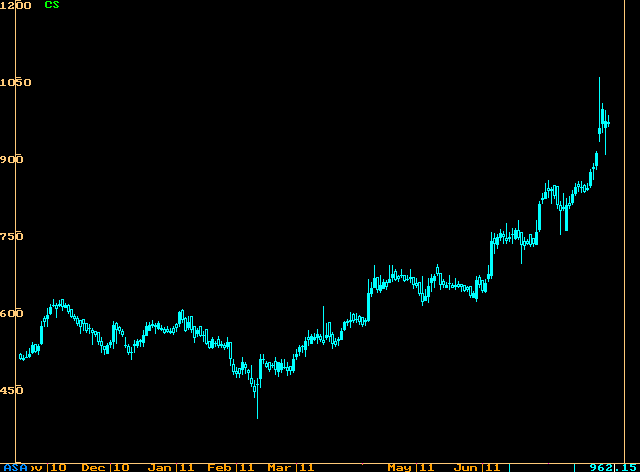
Walt Disney Corporation who is the majority shareholder plans to acquire the shares and delist the company from the Stock exchanges where it is listed. The share has been rising steadily and the price has risen sharply from a level of Rs 386 on the 10th of February to a high of Rs 1050 on the 26th of July and a close of Rs 962.15. All this has happened when the benchmark indices have remained fairly flat. The corresponding level for the BSESENSEX on the 10th of February was 17,463.04 points which has moved up and closed at 18,197.20 points, a gain of a mere 4.20%. The scrip UTV Soft in the similar period has gained Rs 576.15 or a staggering 149.26%.

Walt Disney has informed the company and the company has informed the stock exchange of the decision to delist the company and the said notice is attached. Click here to read the notice to the stock Exchanges.

The delisting norms in India are very clear and a company has to make an offer with a floor price which is based on the weighted average of 2 weeks and 26 weeks and this becomes the minimum price to be offered for delisting. The delisting norms stipulate that the company will undertake a reverse book building and the discovered price may or may not be accepted by the company.
It appears that Walt Disney and its advisors believe that the floor price and ceiling price are the same. The company has mentioned in the letter to the exchanges under point 4 (iii) a commitment by the acquirer that the acquirer will acquire equity shares of the company at a price of Rs 1000 (Rupees one thousand only) per equity share despite the discovered price being less than Rs 1000 (Rupees One Thousand Only) per share; or and under point 4 (iv) a restriction on the board of directors of the Acquirer to subsequently approve an acquisition of shares from the public shareholders at a price in excess of Rs 1000 (Rupees one thousand only ) per equity share.

The important point to be noted is that Walt Disney is offering not only a floor price but also a ceiling price and implying that this is a price at which it will acquire any number of shares like is done in the case of an open offer. The whole deal looks again the interest of minority shareholders and SEBI the regulator should ask the company to explain its stand at the earliest.

Reverse book building implies that once the price is discovered, it is upto the company/acquirer to accept or reject the discovered price and at hat discovered price he has to accept all shares which have been tendered at or lower than that price at the discovered price. The acquirer also has to keep the discovered price open thereafter for all shareholders who have not tendered their shares.

Walt Disney appears to be circumventing the law by mixing an open offer with delisting and confusing minority shareholders. One hopes the regulator SEBI will step in and address the issue at the earliest.
L&T Finance Holdings: Issue price fixed at Rs 52

L&T Finance Holdings limited launched its maiden issue to raise Rs 1,245 crs in a price band of Rs 51-59. The issue received excellent response and the anchor book was done at a price of Rs 56. The environment has become challenging and even though the book was built at Rs 59 the company chose to effectively offer a discount to the now shareholders of the company by pricing the issue at Rs 52.

This should become an eye opener for companies and merchant bankers for the future to price the issue. Here is a company which has its issue subscribed 5.34 times and garners support at the top end of the price band but chooses to price the issue almost at the bottom end of the price band. Against this we have companies which get just about subscribed but price the issue at the top end so that they get some extra money from the public.

A recent example of this is the issue from Bhartiya Global ?Infomedia Limited which was subscribed a mere 2.06 times and did not rteceive a single application from QIB’s priced the issue at the top end of the price band of Rs 82, when the band was Rs 75-82. The net result, the share fell a staggering 62% on day one. Yet another example is that of Readymade Steel Limited which had tapped the capital; markets with an issue in the price band of Rs 90-108. The issue was subscribed a mere 1.68 times with QIB’s subscribing a mere 0.03%. The issue priced at the top end of the price band at Rs 108 and the listing day saw the share fall over 38%.

Very clearly the function of issue pricing is a joint exercise between the promoters of a company and the merchant bankers. Wherever the issue of goodwill and sustainability comes in there would be a soft corner for the investors. I believe this is a shining example which needs to be duplicated by promoters and other merchant bankers to make this market a more healthier place.

ICICI Bank acquires a stake of 29.3% in GTL on taking over pledged shares


ICICI Bank is now the single largest shareholder ahead of promoter Manoj Tirodkar after it assumed a 29.3% stake in the debt laden company GTL. The shares were acquired at a value of Rs 68.2 and at this price the bank has been able to recover Rs 194 crs of the Rs 500 crs that GTL owes it. The total number of shares acquired were28.5 million shares. The promoters’ Global Holding Corp has pledged 99.1% of its 52.18% stake or 50.75 million shares in the company and it would be a matter of time before other bankers would also exercise their lien and take over the shares pledged with them.

This brings us to the question as to what would happen next. Would there be a need for any open offer to be made as in the case of Great Offshore. The happening of Satyam changed the way the Indian Companies Act functions and it make became mandatory to disclose the pledge of shares on a regular basis. In the case of GTL the management control does not change because ICICI Bank has not acquired shares of GTL but they have come to it by default on account of the inability of the borrower GTL to return the money. There would be no need whatsoever to make any sort of open offer by any party now or later if more pledged shares are transferred.

The next course of action would be taken by a consortium of banks. The major liability is on the books of GTL Infra which is a subsidiary of the parent GTL Limited. This company is in the business of owning telecom towers and the lender consortium would now expedite a “slump sale” of the tower business which would reduce the debt on the books and therefore the interest outgo of the company. Currently the company is bleeding very heavily and GTL Infra made a net loss of Rs 139.29 crs for the year ended March 2011.

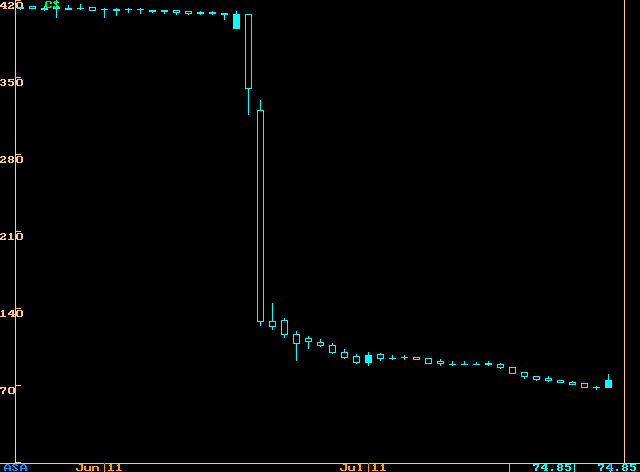
The share price of the company fell dramatically from Friday the 27th of June from a close of Rs 406.95 to Rs 90.75 on the 30th of June. In a mere 10 trading sessions the share price had fallen Rs 316.20 and become a mere 22.3% of its original price. The market sure punished the stock and one is not sure where the pledged shares have gone and whosoever sold them, how come the shareholding pattern does not reflect the same.

Very clearly corporate governance even post Satyam continues to be pathetic and it appears management just does not want to become transparent come what may. They still believe they can run things any which way they like and they are accountable to none.

What should shareholders expect from these companies going forward?

One should expect that there will be urgency in finding a buyer for the tower business and transferring the assets and liabilities of the company to the buyer. As the company has already filed for a CDR (corporate debt restructuring) package, it would make things easier for the restructuring and the sale. Investors should expect the share price to recover from these levels but they should understand that at the end of the day the company is a loss making company and effectively has no promoter who could bring in the money to help in the restructuring of the company. Secondly all the promoter shareholding is pledged and there is no way that there can be redemption or the lien on the pledged shares can be removed.

In conclusion the counters of these two shares would continue to be volatile, news driven but there is no way that any open offer of any sort can come in the near future.

Subscribe to RSS Feed Follow me on Twitter!