
Pledged Shares: The debacle, the risk and a possible remedy

The markets were spooked last week on the pledged shares issue. Many companies were badly affected and this was great stuff for discussion on media channels. First some basic facts about what is needed as per law.

Promoter groups which include promoters, their associates and persons acting in concert have to inform the stock exchanges of any shares that they have pledged. This has to be done each time shares are pledged/unpledged. It is not mandatory as yet to inform the name of the entity to which the shares have been pledged or unpledged. Once the shares are sold by a lender or a person to whom the shares have been pledged, the information that these were pledged shares and have been sold would appear as a declaration from the promoter or promoter group entities. The person or lender who has sold his name would appear in the bulk deals if he has sold 0.5% or more of the equity of the company on a single day. He would not be responsible for giving a declaration under SAST (substantial acquisition of shares and takeovers) regulations 1997, if he does not hold less than 5% or is included in the promoter group.

One would recall some classic cases where the promoter of Great Offshore lost control of the company to Bharti Shipyard after he was unable to repay the mark to market losses on the share. Yet another example was Orchid Chemicals where the promoter almost lost control of the company due to the sale of his pledged shares.

Let us take the example of GTL Limited. The share on Friday the 17th of June opened at Rs 407 against the previous day’s close of Rs 406.95. The share made an intraday low of Rs 316.45 and closed at Rs 339.90. Monday the 20th of June saw a blood bath with the share dropping to an intraday low of Rs 124.10 and closing at Rs 127.80, a loss of Rs 212.10 or 62.4%.
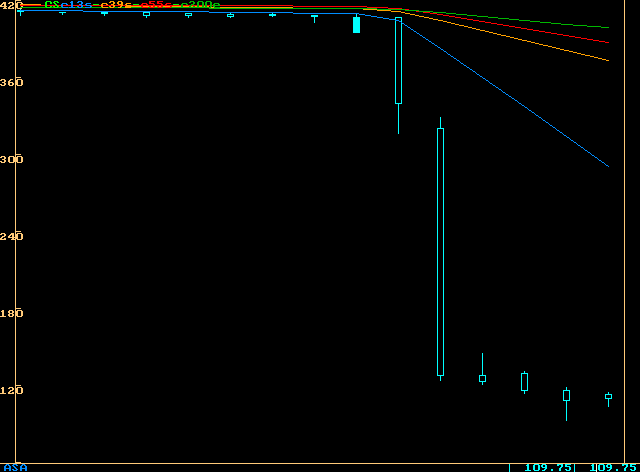
Monday saw huge turnover and deliveries and there is no declaration under SAST that shares have been sold. The question is whodunit? Very clearly shares have been sold for delivery as the names have appeared in bulk trades. They are not part of the promoter group and they appear in all probability to be shares that have been sold against margin calls. With no declaration forthcoming the issue becomes murkier and more intriguing. One interesting thought on the issue is these were “benami” holdings of the promoter group and therefore there has been no declaration so far. The nett loss to the share in a mere six trading sessions is down from Rs 406.95 to Rs 109.75, a loss of Rs 297.20 or 73.03%.

Group company GTL Infra has had also suffered huge losses with the stock falling from Rs 32.05 on Thursday the 16th of June to Rs 16.05 at close on Friday the 24th of June. Net loss is Rs 16 or 49.92%.

The third share to get affected was S Kumars Nationwide where the shares of the promoter were pledged as additional collateral to the lenders consortium IDBI when the company went in for a CDR package. As per the terms of the package, the entire shareholding of the promoters was to be pledged to the leader of the lenders consortium which in this case was IDBI. Shares of this company too got hammered and the price which was at Rs 66.90 on Thursday the 16th of June, hit an intra day low of Rs 41.65 on Tuesday before closing at Rs 52.55 on Friday the 24th of June. The net loss was Rs 14.35 or 21.45%.
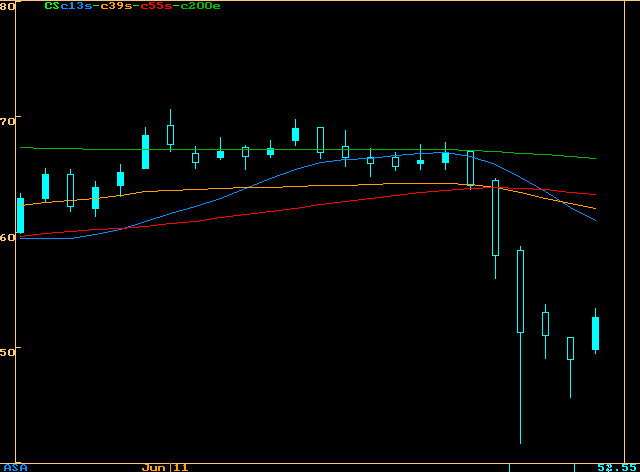
 

The moot point which emerges from all of this is basically two points. The first is that all the shares involved were part of the Futures and options category and therefore easy to trade and one can carry forward the trade from day to day. Second intraday the electronic media and various chat groups etc were active in these counters and brought the price down. The markets were in a negative frame of mind and players took advantage of the same.

What can be done to minimise shareholder being hurt going forward? The name of the lender or person to whom shares are pledged be made mandatory at the time of making the pledge so that the name can be co-related. Secondly when pledged shares are sold of an entity who is labelled as a promoter, the lender or person to whom shares are pledged should give a declaration to the exchanges that he has sold such shares.

I believe these measures will go a long way in instilling some confidence on this issue of pledged shares. As far as the managements are concerned, prompt action by them and proper disclosures will always keep the transparency level high and lead to good corporate governance.

Even this time around quite a few lists of shares and companies where promoter holding is pledged are being circulated and are vulnerable going forward.

I believe one should appreciate the prompt action of the management of S Kumars Nationwide calling for an analyst call on Friday and clarifying the position for all concerned. One hopes that the management of GTL and GTL Infra does clarify the sale by various entities on Monday 20th of June for the benefit of all concerned.

Shriram Transport Finance NCD: Attractive yields of upto 11.60%. Apply

Shriram Transport Finance Company Limited (STFC) is tapping the capital markets with a bond issue of secured Non-convertible debentures aggregating to Rs 500 crs. The company has an option to retain over-subscription upto 500crs, effectively making this an issue of Rs 1000 crs. The face value is Rs 1000, with a minimum subscription amount of Rs 10,000. The issue opens on Monday the 27th of June and closes on Saturday the 9th of July. In case of oversubscription, the allotment would be on the basis of first come first served.

Face Value of Bond Rs 1000 each
Issue Size Rs 1000 crs
Period of Bond 2 options of 3 years and 5 years
Coupon Rate Category I and Category II 11% per annum and 11.10% per annum 
Coupon Rate for Unreserved Individual 11.10% per annum and 11.35% per annum
Coupon Rate for Reserved Individual Portion 11.35% per annum and 11.60% per annum
Category I or Institutional Portion QIB’s 
Category II or Non-Institutional Portion Bodies Corporates and Firms
Category III Unreserved Portion Resident Indian Individuals and HUF’s – application to be above 5 lakhs
Category III Reserved Portion Resident Indian Individuals and HUF’s – application to be upto 5 lakhs
Reservation Category I 10% of issue or upto 100 crs
Reservation Category II 10% of issue or upto 100 crs
Reservation Category III 40% of issue for unreserved category or individuals applying above 5 lacs
Reservation Category III 40% of issue for unreserved category or individuals applying upto 5 lacs
Lead Managers to the Issue JM Financial Consultants Private Limited
ICICI Securities Limited
Co-Lead Managers to the Issue R R Investors Capital Services (P) Limited
Karvy Investor Services Limited
Isssue Opening Date Monday 27th June 
Isssue  closing date  Saturday 9th July
Credit Rating CRISIL AA/Stable and CARE AA+
Paid -up Capital  22,61,84,068 Equity Shares 
Market Cap as on 24th June 2011 Rs 13,581.22 crs
Bid Lot 10 bonds
Bidding Amount for Retail 500 bonds of Rs 1000 each or 5 lakhs
Listing of Bonds National Stock Exchange
Interest on Application 2.5% per annum on application 
Interest on Allotment 7% per annum on allotment 
Allotment On first come first served basis

Business
STFC as the name suggests is in the business of financing pre-owned commercial vehicles. STFC is the largest Indian asset financing company. The company provides financing for commercial vehicles and its primary borrowers are FTUs (first time users) and SRTOs (small road transport operators). It finances commercial vehicles, passenger commercial vehicles, multi-utility vehicles, three wheelers and also working capital requirements for FTUs and SRTOs. Recently the company has extended its services by providing loans for the purchase of equipment used in the infrastructure industry, and also for tractors.
The company was established in 1979 and has been in business now for over 32 years. The company is registered as a deposit taking NBFC with RBI since September 2000. The company has assets under management of over Rs 36,000 crs and the same have grown from Rs 29,000 crs in the previous year. In terms of size of the bond issue of Rs 1000 crs, this would amount to a requirement of a mere 15 days or less.

Objects of the debenture issue
The funds raised through this issue after meeting the expenditures of and related to the issue, will be used for our various financing activities including lending and investments, subject to applicable statutory and/or regulatory requirements, to repay our existing loans and our business operations including for our capital expenditure and working capital requirements.

Tenure and coupon rate
The company has divided the applicants into four broad categories. They are as follows: –

  1. Category I.   Comprising of QIB’s
  2. Category II.  Comprising of corporates and other bodies not eligible as QIB’s.
  3. Category III  Comprising of HNI’s or retail applicants who subscribe for over 5 lacs
  4. Category III – Reserved. Retail applicants who apply upto five lacs.

There is a reservation for each category with 10% each being reserved for Category I and Category II. The remaining of the issue is reserved for individuals with 40% reserved for individuals applying for 5 lacs and more and 40% reserved for individuals applying for upto  Rs 5 lacs.
There are two durations for each of the categories namely 3 years and 5 years. The payment of interest is annual. The coupon rate is 11% for 3 years and 11.10% for 5 years in Category I and Category II. In Category III, the HNI’s or applicants above Rs 5 lacs would get 11.10% for 3 years and 11.35% above 5 years. The retail category which is upto Rs 5 lacs would get 11.35% for 3 years and 11.6% for 5 years. 
The company would also pay interest on the application money at the rate of 2.5% if allotment is not made and at the rate of 7% if allotment is made.

Financials
Though this is a bond issue and the company has very good ratings from credit agencies like CRISIL AA/Stable and CARE AA+ it still makes sense to talk about the financials. The total income has grown from Rs 4,496 crs in the financial year ended March 2010 to Rs 5,511.98 crs in the year ended March 2011. The net profit after tax has grown from Rs 873.1 crs to Rs 1,217.12 crs respectively.

Rupees in crores year 2010 year 2011
Income from operations 4399.06 5312.34
Other Income 96.88 199.64
Total Income 4495.94 5511.98
Interest Expense 2246.81 2274.32
Other Expenditure 924.56 1400.12
Total Expenditure 3171.37 3674.44
Profit Before Tax 1324.57 1837.54
Tax payments 451.47 620.42
Net Profit After Tax 873.1 1217.12

Conclusion
SBI had come out with a bond issue where the coupon rate was 9.95% for retail investors and now STFC is offering secured debentures with a five year maturity at 11.6% coupon rate. These debentures would be listed on the NSE and there have been some concerns about liquidity of trading on the bond exchange. As far as a retail investor is concerned there would be no concern as these bonds would have some trading and there would be ample demand at a price which is yield effective at the current rate of interest.
I believe investors should apply for these secured debentures as they are attractively priced from a yield perspective and offer decent returns to investors. People applying in the retail category must apply on day one as there is a risk if the issue gets oversubscribed of non-allotment.

SEBI disclaimer: – I intend to subscribe to the above issue.

AVOID Readymade Steel India IPO: Valuations of between 36 times and 41 times

Readymade Steel India Limited (RMS) is tapping the capital markets with its IPO to raise Rs 3474.53 lacs in a price band of Rs 90-108. The issue opens on Monday the 27th of June and closes on Wednesday the 29th of June.

This is one more of those IPO’s who have chosen to not have a road-show to discuss and highlight the company. Is it to avoid embarrassing questions about the valuation or is it a convenient way to generate higher interest through curiosity is something one would never know.

Price Band  Rs 90 – Rs 108
Offer size in shares 38,60,589 Equity Shares at Rs 90 to 32,17,157 Equity Shares at Rs 108
Issue Size Rs 3474.53 lakhs
QIB’s 19,30,294 Equity Shares at Rs 90 to 16,08,579 Equity Shares at Rs 108
Non Institutional Investors 5,79,088 Equity Shares at Rs 90 to 4,82,574 Equity Shares at Rs 108
Retail Investors 13,51,206 Equity Shares at Rs 90 to 11,26,005 Equity Shares at Rs 108
Book Running Lead Manager Arihant Capital Markets Limited
Issue Opening Date Monday 27th June
Issue  closing date  Wednesday 29th June
IPO Grade  CARE grade 2/5 indicating below average fundamentals
Paid -up Capital Pre IPO 85,01,200 Equity Shares 
Paid -up Capital Post IPO 1,23,61,789 Equity Shares at Rs 90 to 1,17,18,357 Equity Shares at Rs 108
Market Cap post listing Rs 111.26 crs at lower band to Rs 126.56 crs at higher band
Bid Lot 60 shares
Bidding Amount for Retail 1800 shares at Rs 108 or Rs 1,94,400 per application

Business
RMS is in the business of processing of steel used in the construction industry. The main product is reinforcement bars into various shapes and sizes like cranked bars, stirrups, verticals, column/beam cages etc. Traditionally in the construction activity, the process of cutting and bending steel and fabrication of cages was done on the construction site through manual process resulting in huge wastage of materials, increased requirement of labour and space at the construction site. RMS does the processing of steel through use of automated machines and delivers ready to use cut and bend steel rods, prefabricated cages and other steel products required for construction activities. This process is faster, more efficient and uses lesser material as there is virtually no wastage in the process.   

The product offerings include ready to use steel primarily re-bars to be used in the construction activities in various sectors like roads, power plants, ports airports, housing, bridges, metros, monorails etc. The product offerings are aimed at overcoming the time and space constraints of construction activity of the clients in Western India. The plant is located in Khopoli.
This business could be compared with the business of Ready mix concrete (RMC) which began in the mid ‘90s. Today one cannot imagine a project coming up without the use of ready-mix concrete. IT is believed that going forward the business of readymade steel would be like ready mix concrete.

The present capacity at Khopoli is 27,000 tons per annum which is proposed to be expanded to 90,000 tons. The two new facilities near New Delhi and at Raipur would be of 50,000 tons each. This translates into a combined enhanced capacity of 1,90,000 tons which would be an expansion of seven times the existing capacity.

Objects of the issue
The objects of the issue are as follows: –

  1. To part finance the cost of enhancing the capacity at our existing facility at Khopoli and the cost of setting up new facilities near New Delhi and Raipur.
  2. To meet the pre-operative expenses including issue expenses.
  3. To meet margin money requirements of working capital
  4. To meet the general corporate purposes.

Project Cost of the expansion

Enhancement of capacity at Khopoli Rs 1013 lacs 
New Delhi Rs 1662 lacs
Raipur Rs 1587 lacs
Pre-operative expenses including issue expenses Rs  826  lacs
Margin money requirement for working capital Rs 1033 lacs
Total Project Cost Rs 6121 lacs

The company has done a pre-ipo of 7,61,000 shares and raised Rs 656.48 lacs. The company has also been sanctioned a term loan of Rs 1509.57 lacs.

Financials
The turnover of the company has increased from Rs 450.69 lacs in March 2009, to Rs 3223.82 lacs in March 2010 to Rs 8144.51 lacs in the nine months ended December 2010. The net profit after tax was Rs 18.561 lacs, Rs 42.53 lacs and Rs 232.05 lacs respectively.

Rupees in Lakhs year 2009 year 2010 9 months 
Dec-10
Products Processed Sales 450.69 3223.82 8144.51
Trading Sales 38.79 13.61 16.38
Total sales 489.48 3237.43 8160.89
Other Income 11.66 8.96 0.70
increase/decrease in stock 153.50 558.49 332.12
Total Income 654.64 3804.88 8493.71
Total Expenses 627.63 3728.49 8125.40
Profit before tax 27.01 76.39 368.31
Taxes 8.40 33.86 136.26
Net Profit After Tax 18.61 42.53 232.05
NET MARGINS 2.84 1.12 2.73

Comparisons
There are no direct competitors of the company who are engaged in the similar line of activity. However there are some new entrants who have entered the same business in Western India where the company is currently selling its products. There would be many new entrants entering this sector going forward and there would be competition in the business. This is a conversion unit and there would be competitive margins which would be earned by the industry.

Valuations
Based on the net profit for the nine months ended December of Rs 232.05 lacs, if one were to annualise the same the net profit for the year ended March 2011 would be Rs 309.4 lacs. If one were to assume the lower end of the price band of Rs 90, the fully diluted equity would be 123.62 lac shares, which would correspond to an EPS of Rs 2.5 per share. At the upper end of the price band of Rs 108, the fully diluted equity would be 117.18 lac shares, and the EPS would be Rs 2.64.
The price earnings multiple based on fully diluted equity and annualised earnings based on December 2010 would be 36 times at the lower end of the price band and 40.91 times at the upper end of the price band.

Conclusion
There is no way that one can justify a price earnings multiple of between 36 times and 40.91 times. The company is going in for an expansion of seven times its existing capacity which is by no means small or simple to achieve. The expansion and successful implementation of the expansion and achieving a high capacity utilisation would take some time to achieve. The turnover would certainly increase but margins in this business of conversion would always remain low.
It makes sense to stay away from the issue even though it seems a new concept. The size of the issue and the asking price earnings multiple make investment risky. The only saving grace could be listing gains as we have seen in the past that many small cap stocks generate listing day gains because of “friendly” intermediaries before disappearing into the distant horizon.
I would advise people to avoid the issue.

SEBI Disclaimer: – I do not intend to apply for the issue.     

Subscribe to RSS Feed Follow me on Twitter!