
Standard Chartered Bank IDR: An update after Monday’s bloodbath

Standard Chartered Bank IDR saw a bloodbath on Monday the 6th of June when trading began after the announcement from SEBI over the conversion rules which were announced on Friday the 3rd of June.

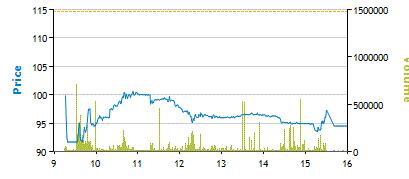
Trading volumes started reducing and the IDR has become a non-event after the initial explosive volume which happened on Monday, the first day of trade after the rules were announced.

During the week, I have spoken to various people from the investment community and found out what has happened which prompted such a move from the regulator. It appears SEBI was very keen to introduce a new platform like the GDR (Global Depository Receipts) traded in Luxembourg and ADR (American depository Receipts) traded in the US, in India. Accordingly the first ever IDR was launched in May 2010 with the Standard Chartered Bank PLC. It unfortunately remained the one and only IDR ever and despite of the best efforts of all concerned, no other issuer of capital was interested in coming out with an IDR issue.

It appears the launch of the IDR was without considering the effect that the conversion would do to the issue. If one looks at the trading pattern of GDR’s in Luxembourg whenever they have traded at a discount which makes arbitrage affordable, investors have bought GDR’s and converted the same to the underlying shares and sold at a profit. This would certainly have happened in the case of the Standard Chartered Bank issue as well. Anticipating this it appears SEBI issued instructions and said that the rules are being changed one week before the mandatory period of one year from listing was to be completed.

Investors of all categories are being debarred the right to make their legitimate money and this has been curtailed by one action from the regulator. I am not sure whether this action could be challenged in a court of law or whether SAT (Securities Tribunal Appellate) is the right forum to take up this issue.

BSE NSE Total
Date Traded Qty Delivery Del % Traded Qty Delivery Del % Traded Qty Delivery Del %
7th June 5739609 2745239 47.83 13071595 8068248 61.72 18811204 10813487 57.48
8th June 1703019 1169051 68.65 2259365 1756316 77.73 3962384 2925367 73.83
9th June 862501 523852 60.74 1227199 810934 66.08 2089700 1334786 63.87
10th June 293812 235045 80.00 827040 628899 76.04 1120852 863944 77.08
Total 8598941 4673187 54.35 17385199 11264397 64.79 25984140 15937584 61.34

A table is enclosed showing the daily traded volumes on the two exchanged from Tuesday to Friday of this week. One can see the volumes are falling and the delivery percentage is fairly high with an overall delivery percentage of 61.34%. The volume has been reducing on a daily basis from 188 lacs on Tuesday to just a shade over 11 lacs on Friday.

I believe with the new guidelines for conversion into underlying shares only if the traded volume becomes insignificant or becomes infrequently traded is a sure way of ensuring that no future IDR’s ever happen. It is also a sure way of ensuring that the one and only IDR which is listed continue to remain listed.

The whole idea of writing about this issue is that the community needs to take up this issue. The regulation which has been enacted appears against the interest of the investing community and  appears something which has been done with a retrospective effect.
Performance of Newly Listed Shares as on 10th June 2011

Name Date of Listing Issue Price closing  price closing price % gain loss change over
10th June 27th May over week lssue price
Muthoot Finance 6th May 175.00 164.55 177.45 -7.27 -5.97
Paramount Printpackaging 9th May 35.00 22.8 24.05 -5.20 -34.86
Future Ventures India 10th May 10.00 9.13 8.09 12.86 -8.70
Servalakshmi Paper 12th May 29.00 10.19 10.43 -2.30 -64.86
Innoventive Industries 13th May 117.00 95.95 98.3 -2.39 -17.99
Sanghavi Forging & Engg 23rd May 85.00 61.35 65.85 -6.83 -27.82
Power Finance (FPO) 26th May 203.00 200.65 203.9 -1.59 -1.16
Aanjaneya Lifecare 27th May 234.00 325.35 355.05 -8.37 39.04

Standard Chartered PLC IDR: Makes 52 week low on SEBI conversion norms


Standard Chartered Bank PLC IDR which is India’s first and only IDR was mercilessly hammered after SEBI announced on Friday the 3rd of June the conversion norms into underlying. At the time of issue it was made very clear by the whole management team of Standard Chartered and the host of merchant bankers that they had employed to sell the issue that conversion would happen after one year and that the same would be allowed for the purpose of selling the share. What this effectively meant that shares of the bank could not be held as shares and had to be compulsorily sold.

Prior to this announcement the IDR’s were actively traded and had decent volumes but the average was below a million shares. What one saw on Monday was a near panic on the counter and it not only made a new 52 week low it also was at a 20% down circuit for some time.

Exchange  Prev Close Open  High Low Close Net Change % Gain/loss Wt. Avg Volume Delivery  Del %age
BSE 114.65 100.00 101.70 91.75 94.55 -20.10 -17.53 95.92 18265974 10716957 58.67
NSE 114.85 100.00 101.70 91.90 95.05 -19.80 -17.24 95.90 32177124 21994990 68.36
Total                 50443098 32711947 64.85

The combined volume on the two exchanges was a staggering 504.43 lac IDR’s against an average of below 10 lac shares historically. The delivery volume was 327.12 lac IDR’s or a staggering 64.85%. The sellers were basically FII’s, arbitrage funds and some of the names of the sellers are as follows: –

Seller    Quantity Rate
Credit Suisse 34,98,404 94.37
Credit Suisse 20,51,004 97.45
Deutsche Securities 13,00,000 96.32
Swiss Finance Corporation 70,05,716 95.70
Swiss Finance Corporation 45,45,367 95.29
TOTAL 1,84,00,491  

On the buy side there were two institutions who bought as well.

ICICI Prudential 29,81,703 96.98
Swiss Finance Corporation 7,50,000 93.65
TOTAL 37,31,703  

The price chart shows that the stock hit the down circuit right at the beginning of the day’s trade. It recovered from there and made the days high. Thereafter the share again drifted down and saw huge volumes throughout the day.

The panic was across the board and people have sold like there is no tomorrow. The identity of a very small percentage of the buyer is known while the major portion remains still unknown. The new SEBI directive says that the IDR would only be convertible into the underlying if the IDR trading volume becomes “ILLIQUID”. The definition of the same is that in a block of six months the traded volume should be less than 5% of the outstanding IDR’s.

This definition brings about a trick situation. When the volume falls, and there is a substantial price arbitrage available, there would be buying interest which would increase volumes and therefore the illiquid status would be breached.

The announcement by SEBI on Friday evening brings one to a moot point whether this amounts to leaving investors high and dry with a mere one week left for conversion of IDR’s into underlying. It also brings up an interesting question whether shareholders or investors have been misled into buying something where they believed and opportunity to make money existed and the rules have been changed.

Yet another way of looking at it is that SEBI was very keen on introducing IDR’s into India and launched the first issue without understanding the implications or effect that this could have later on. Today they have come out with rules which give an impression that the effort is to contain the outflow of money from India. If that be the case as the figures show FII’s have been big sellers and the idea stands defeated.

I would like to raise an issue through this article, that whether the act of the company and its merchant bankers in selling this issue without having clarity on the conversion of IDR into underlying shares amounts to miss-selling or not. Do investors who have applied and lost huge money have reason to complain against the company and its merchant bankers? Could a class action suit like in the case of Mahindra Satyam be brought against this company and be settled as the law allows for US investors? Will the Indian shareholders be left twiddling their thumbs because there is no such law in this land? Will the mutual funds who have to take a stand when minority shareholders’ interests are hurt or violated or will they just keep quiet and let their investors suffer as well?

I believe these question need to be answered by Standard Chartered and their merchant bankers and in the greater interest of the capital markets they must make a representation to the regulator on the issue.

  If one were to make a one line comment on the above issue it is the end of IDR’s in India and the community will have a lot to do and answer before we ever see the light of another IDR in this country.
R I P. Rest in Peace
Subscribe to RSS Feed Follow me on Twitter!